
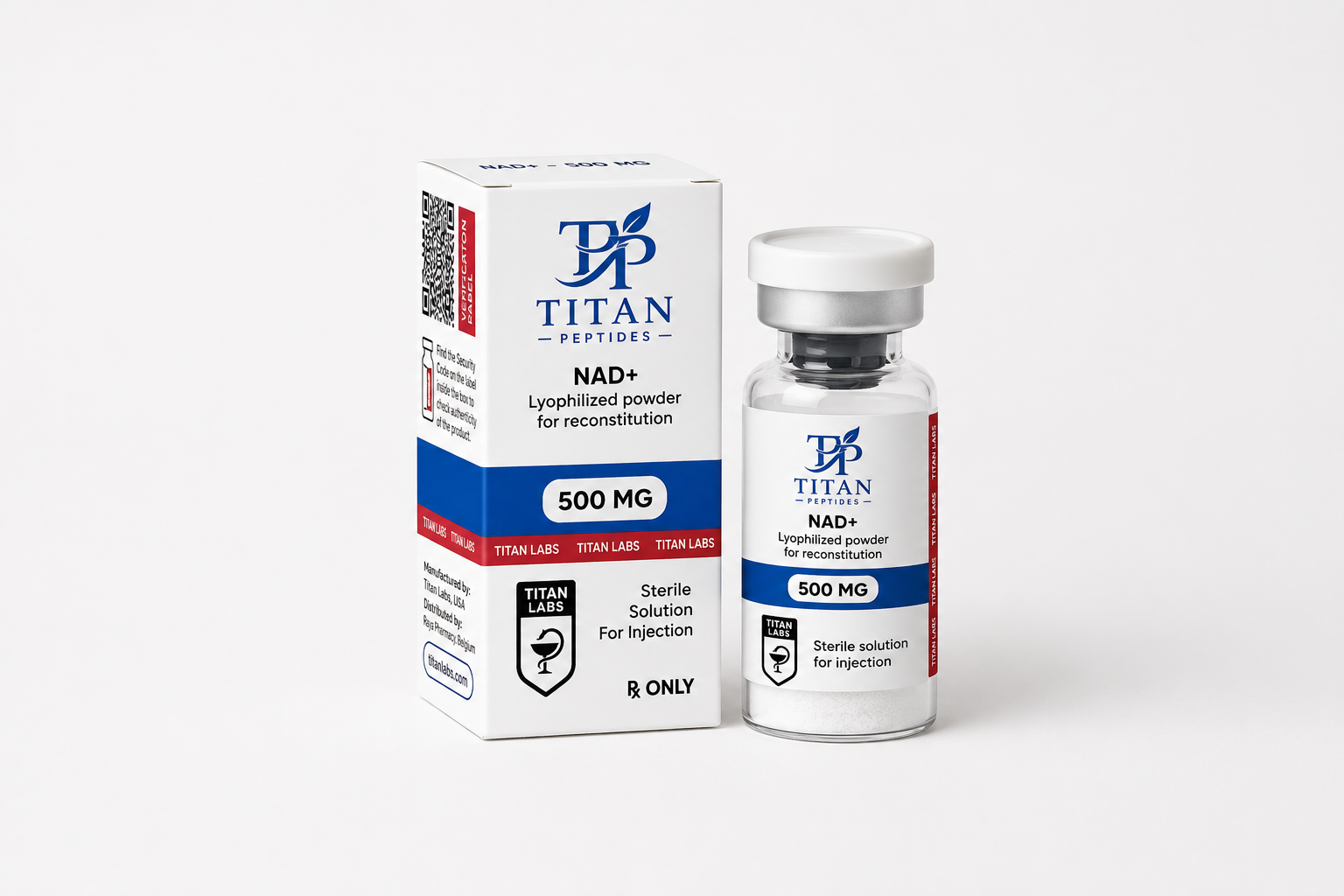
NAD+ (500 MG/VIAL – 1 VIAL)
$52.00
NAD+ (Nicotinamide Adenine Dinucleotide) is a naturally occurring coenzyme found in every living cell and is essential for cellular energy production and metabolic function. It is widely used in bodybuilding and performance-focused communities for its association with improved energy levels, enhanced recovery, and support for overall cellular health
NAD+ 500mg
In contemporary metabolic research, nad+ 500mg serves as a crucial biochemical tool for exploring the complex cellular pathways that govern energy production and aging. Nicotinamide adenine dinucleotide (NAD) is a fundamental coenzyme found in every living cell, acting as a primary electron transporter during cellular respiration. The molecule alternates between its oxidized form (NAD+) and reduced form (NADH) to drive the production of adenosine triphosphate (ATP) inside the mitochondria. As cellular organisms age, native baseline levels of this coenzyme naturally decline, making the study of external supplementation a high-priority front in longevity science.
When evaluating nad+ 500mg under high-performance liquid chromatography, researchers focus on its capacity to activate specific cellular defense networks. In vitro models suggest that increasing available concentrations of this compound can stimulate sirtuins, which are a class of proteins closely linked to DNA repair, mitochondrial biogenesis, and the regulation of systemic oxidative stress. Furthermore, research points to improved cellular signaling across multiple organs, including enhanced metabolic pathways in liver tissue, optimized insulin response models in the pancreas, and improved nitric oxide pathways that support healthy vascular blood flow.
However, analytical teams must note a critical detail in current scientific literature: while the biological mechanisms of the native coenzyme are well-mapped, clinical data regarding direct oral or structural supplementation remains actively debated. Studies on healthy, young cell cultures indicate they generally maintain optimal native levels, meaning extra exposure yields minimal functional change. Conversely, tissue models mimicking age-related decline or specific metabolic disorders demonstrate a far more pronounced response, highlighting why accurate nad+ 500mg reconstitution and dosage planning is necessary to isolate these variable data curves.
How to reconstitute nad+ 500mg
Transforming a high-mass lyophilized cake into a stable liquid reagent matrix requires meticulous laboratory technique to avoid degrading the active coenzyme structure. When mapping out the protocol for how to reconstitute nad+ 500mg, technicians must prioritize sterile environmental controls and low-mechanical force fluid introduction. Because a 500mg mass represents a significantly larger quantity of raw material than standard micro-gram peptides, the cake requires a structured solvent interface to dissolve fully without clumping or suffering structural precipitation.
Use sterile Bacteriostatic Water (0.9% benzyl alcohol) for optimal stability. Draw the fluid into a syringe, position the needle against the inner glass wall, and slowly depress the plunger so the solvent streams down the side rather than hitting the powder directly. Gently swirl the vial in a slow, circular motion to dissolve. Never shake the vial or use a vortex mixer, as harsh physical force causes foaming and breaks down the delicate nucleotide linkages.
How much bac water for 500mg nad
Because of the exceptionally high mass of the compound inside a 500mg vial, choosing the correct volume of solvent is the single most important factor for preventing concentration errors. Deciding exactly how much bac water for 500mg nad to introduce depends entirely on your target milligrams-per-milliliter concentration requirements for the planned cellular assay. Because this is a high-mass configuration, utilizing too little liquid will result in a highly viscous, over-saturated solution that can clog micro-pipettes and complicate automated fluid dispensing.
The standard scientific baseline models for a 500mg freeze-dried cake utilize either 5.0 mL or 10.0 mL of bacteriostatic water to achieve clean, highly calculable concentration profiles:
5.0 mL Reconstitution: Adding exactly 5.0 mL of bacteriostatic water creates a highly concentrated fluid baseline mapping out to precisely 100 mg of active compound per milliliter of solution (100 mg/mL).
10.0 mL Reconstitution: Adding exactly 10.0 mL of solvent yields a highly balanced, fluid-handling optimized matrix mapping out to precisely 50 mg of active compound per milliliter of solution (50 mg/mL).
Choosing the 10.0 mL baseline configuration is highly recommended by analytical testing centers because it delivers a fluid density that remains easy to draw, store, and manipulate across successive multi-well assay extractions without risking localized crystal formation.
Evaluating Metabolic Variations and Research Outcomes
When studying the impact of the coenzyme across varying metabolic conditions, contemporary data shows highly mixed responses depending on the baseline health of the model. In studies evaluating type 2 diabetes and prediabetic conditions, research utilizing postmenopausal models noted measurable improvements in peripheral insulin sensitivity. However, parallel studies tracking models with elevated weight metrics showed no significant alteration in baseline blood sugar or hemoglobin A1C levels, though an isolated increase in local pancreatic insulin production was documented.
Similar variances occur in cardiovascular and neurodegenerative research models. When introduced to healthy tissue layers, the coenzyme appears to lower arterial stiffness and regulate blood pressure metrics, while also showing a capacity to increase high-density lipoprotein (the good cholesterol) in specific female tissue assays. In advanced heart failure models, researchers have recorded a sharp reduction in systemic blood inflammation markers. Furthermore, data tracking neurodegenerative progression like Parkinson disease shows that steady exposure can decrease inflammatory markers within spinal fluid, offering a protective pathway that may slow cellular degradation. Conversely, current studies tracking fatty liver diseases have not yet shown a strong link between supplementation and the direct reduction of liver fat accumulation, reinforcing that outcomes remain highly tissue-specific.
Dosinghttp://google.com Thresholds and Side Effect Profiles in Academic Literature
Understanding the boundaries of high-concentration exposures is critical for preventing cellular toxicity and avoiding erratic data drift in laboratory arrays. Most contemporary experts agree that younger, healthy cellular models do not benefit from external coenzyme exposure. When investigating nad+ 500mg reconstitution and dosage limits, researchers must understand that the molecule behaves essentially as a highly advanced form of vitamin B3, which can present clear side effects when applied at excessive thresholds.
In standard comparative research models, keeping concentrations within a verified daily equivalent range minimizes stress markers. At moderate saturation levels, mild variations like localized cell stress, minor changes in replication cycles, or transient flushing responses may occur. However, when exposure lines spike beyond 1000 mg daily equivalents, severe cellular stress markers begin to surface. These extreme boundaries can trigger cellular fatigue, low pressure dynamics, elevated glucose readings, and potential liver cell damage. Keeping your research models strictly aligned with verified, low-to-moderate concentration exposures ensures the integrity of your dataset and prevents accidental cell death.
Technical Specification Matrix
Analytical Variable: Certified Laboratory Baseline
Primary Structural : NAD+ (Nicotinamide Adenine Dinucleotide Oxidized Form)
Main Configuration: nad+ 500mg Lyophilized High-Mass Vial
Molecular Formula Profile: C21 H27 N7 O14 P2
Exact Molar Mass: 663.43 g/mol
Reconstitution Metric: Configured via how much bac water for 500mg nad protocols
Purity Score Validation: Greater than or equal to 99.0% via HPLC and Mass Spectrometry
Physical Solid Matrix: Clean white high-mass lyophilized powder cake
Storage Temperature Profile: Liquid matrix must be kept continuously at 2 to 8 degrees Celsius
Be the first to review “NAD+ (500 MG/VIAL – 1 VIAL)”
Related products
Reviews
There are no reviews yet.