
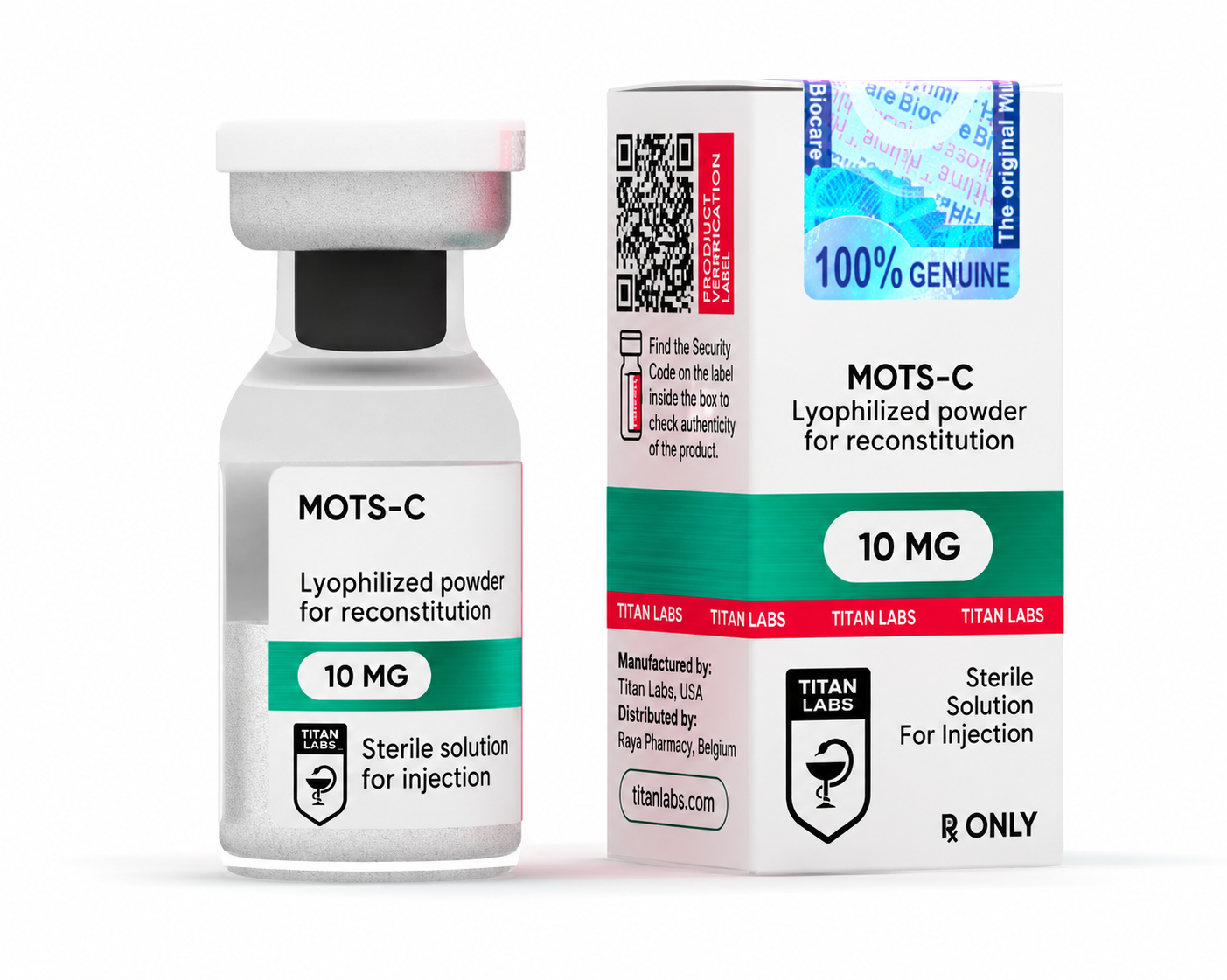
MOTS-C 10 mg
$41.00
MOTS C (Mitochondrial Open Reading Frame of the Twelve S rRNA-c) is a 16-amino acid mitochondrial signaling peptide that regulates metabolism. It switches cells to fat burning, improves insulin sensitivity, increases endurance, and slows aging. It is actively used to optimize metabolism and energy production.
MOTS-c is synthesized directly in mitochondria (the “power plants” of cells) and is transported to the nucleus, regulating gene expression and adapting the body to metabolic stress. Under natural conditions, MOTS-c levels in the body increase in response to exercise, leading some studies to consider the peptide an “exercise mimic.”
Structural Analysis of MOTS C 10mg
In the expanding field of contemporary cellular biology, the discovery of mitochondrial-derived peptides has rewritten traditional understandings of intracellular signaling. While the vast majority of regulatory peptides are transcriptionally mapped from the nuclear genome, mots c 10mg represents a revolutionary class of metabolic signaling agents encoded directly within the mitochondrial DNA. Specifically located within a short open reading frame of the 12S ribosomal RNA gene, this highly compact 16-amino acid sequence controls a systemic retrograde communication pathway that bridges mitochondrial health with nuclear gene transcription.
When evaluating mots c 10mg under rigorous analytical parameters, investigators observe unique structural attributes that distinguish it from nuclear-derived hormones. The peptide maintains a highly hydrophobic core sequence, which plays a fundamental role in its ability to cross both the internal mitochondrial membrane and the external cellular lipid bilayer. Under baseline homeostatic conditions, the peptide operates locally within the cytoplasm. However, when metabolic stress vectors or nutrient deprivation arrays are introduced to the cell culture, the molecule undergoes a distinct conformational shift, triggering swift nuclear translocation where it alters transcriptional expressions linked to cellular survival, oxidative stress mitigation, and healthy longevity models.
Evaluating Brand Alternatives: Pure Bio Labs MOTS-C Vial 10MG
As global research demand for high-stability mitochondrial vectors increases, finding a reliable, chemically pure manufacturing lot remains an ongoing logistical challenge for independent institutions. Many online vendors market items such as the pure bio labs mots-c vial 10mg array; however, varying standards in raw solid-phase peptide synthesis frequently introduce batch variations. Unverified third-party sources often present significant percentages of structural impurities, residual TFA salts, or moisture contamination that destabilizes the fragile 16-amino acid chain during storage.
Titan Research Peptides sets an uncompromised quality standard that goes far beyond generic catalog sellers. Every individual vial of mots c 10mg distributed through our secure platform undergoes rigorous validation using High-Performance Liquid Chromatography to ensure an absolute structural purity profile exceeding 99.0%, paired with structural Mass Spectrometry verifying correct molecular weight confirmation (2174.62 g/mol). Unlike standard grey-market options like the pure bio labs mots-c vial 10mg, our premium reagents are vacuum-sealed inside sterile medical-grade borosilicate glass vials immediately following the lyophilization stage, entirely eliminating the risk of structural degradation or atmospheric moisture exposure.
how to reconstitute mots c 10mg
The physical restoration of a freeze-dried peptide cake into a highly uniform, analytical liquid matrix requires precise laboratory technique to protect the fragile amino acid bonds from mechanical damage. When determining how to reconstitute mots c 10mg, the selected diluent matrix must provide long-term antimicrobial stability while maintaining the localized pH value necessary to keep the peptide fully dissolved.
The standard scientific protocol requires utilizing sterile Bacteriostatic Water (0.9% benzyl alcohol) as the primary dissolving agent. Because mots c 10mg features a specific hydrophobic core structure, rushing the liquid introduction process can result in localized molecular shearing or cloudiness. Technicians must draw the required fluid into an insulin syringe, place the needle against the inner glass wall of the vial, and slowly depress the plunger to allow the fluid to drop naturally down the glass side. Once the solvent is fully introduced, the vial should be gently rotated in a slow, horizontal circular movement. The vial must never be shaken or subjected to high-energy vortex mixing, as severe mechanical force can snap the delicate terminal arginine bonds, rendering the compound inert.
how much bac water for 10mg mots c
To determine the exact liquid volume required for precise concentration scaling, laboratory teams must analyze their liquid handling capabilities. Deciding how much bac water for 10mg mots c depends entirely on the desired concentration ratio per micro-dose. Most analytical software programs prefer a clean, standardized ratio that simplifies calculations during repeated micro-pipetting steps.
The standard scientific baseline involves adding either 1.0 mL or 2.0 mL of bacteriostatic water directly into the 10mg freeze-dried powder cake:
1.0 mL Reconstitution: Yields a high-strength concentration mapping out to exactly 10 mg of active peptide per milliliter of solution (10 mg/mL).
2.0 mL Reconstitution: Creates a more balanced solution mapping out to exactly 5 mg of active peptide per milliliter of fluid (5 mg/mL).
By opting for a clean, round baseline volume, research teams can maintain strict control over their experimental variables, ensuring that successive liquid extractions remain perfectly consistent across multi-week cell culture exposures.
Automated Calculation and the MOTS C 10MG Dosage Calculator
Because mitochondrial-derived compounds function via highly sensitive dose-dependent pathways, relying on an advanced mots c 10mg dosage calculator layout is highly recommended to eliminate human mathematical errors during assay planning. Because insulin syringes utilize a volumetric scale calibrated in units rather than milligrams, a standardized digital parsing system bridges the gap between raw metric mass and fluid volume.
For instance, when utilizing a standard 100-unit (1.0 mL) syringe with a vial that has been dissolved with 2.0 mL of bacteriostatic fluid, the programmatic logic of a mots c 10mg dosage calculator reveals that each individual unit tick mark on the syringe sleeve represents exactly 50 mcg of active peptide. If the active cell culture assay requires a precise exposure threshold of 2.5 mg of the compound, the calculator confirms that the fluid pull must sit exactly at the 50-unit line. Utilizing these automated verification systems guarantees dataset reproducibility, mitigates volume variations, and protects delicate laboratory arrays from accidental compound saturation errors.
Technical Specification Matrix
Analytical Variable: Certified Laboratory Baseline
Primary Structural Keyword: MOTS-c (Mitochondrial Open Reading Frame 12S rRNA-c)
Alternative Keyword Verification: Compares to pure bio labs mots-c vial 10mg parameters
Molecular Formula Profile: C101 H152 N28 O22 S2
Exact Molar Mass: 2174.62 g/mol
Reconstitution Fluid Variable: Validated via how much bac water for 10mg mots c protocols
Purity Score Validation: Greater than or equal to 99.0% via HPLC / Mass Spectrometry
Physical Solid Matrix: Lyophilized crisp white powder cake
Storage Temperature Profile: Reconstituted liquid must remain at 2 to 8 degrees Celsius
Strict Institutional Disclaimer: All chemical compounds distributed by Titan Research Peptides are engineered exclusively for in vitro laboratory analysis, metabolic path tracing, and independent scientific evaluation. These materials are completely banned for human therapeutic use, personal ingestion, or veterinary applications. Any deployment of these substances outside of controlled laboratory settings violates regulatory safety standards.
Be the first to review “MOTS-C 10 mg”
Related products
Reviews
There are no reviews yet.