
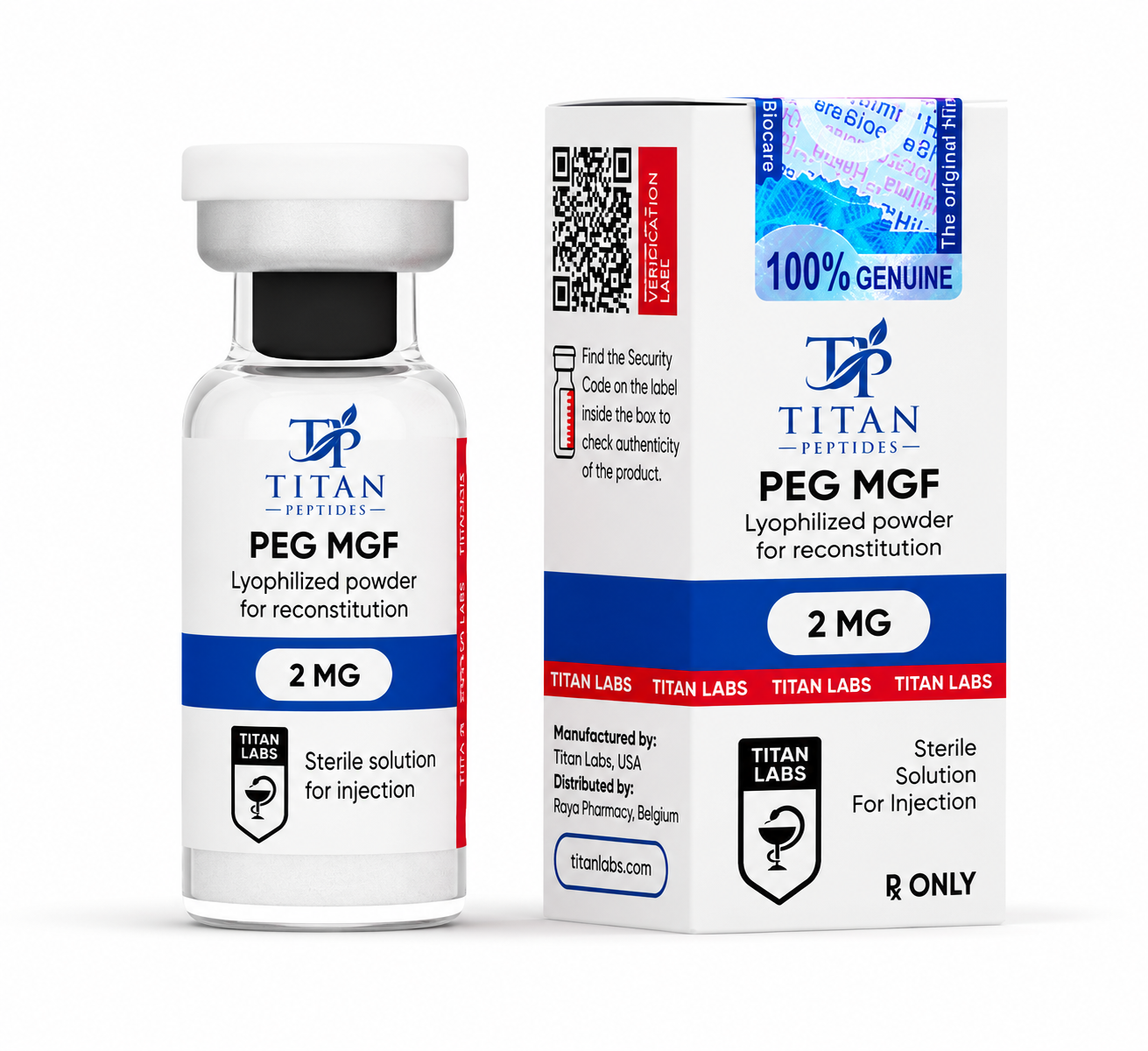
PEG MGF (2 MG/VIAL – 1 VIAL)
$29.00
Pegylated Mechano Growth Factor (PEG MGF) is a variant of the IGF-1 (insulin-like growth
factor-1), which stimulates myoblasts division and allows for muscle fibers to fuse and
mature. This is a process required for growth of adult muscle. The difference between IGF-1
and MGF is that MGF stimulates myoblasts division through stimulation of different
receptors.
Product Overview
PEG MGF (Pegylated Mechano-Growth Factor) is a highly stable, truncated variant of Insulin-like Growth Factor 1 (IGF-1) that has been chemically bound to a polyethylene glycol (PEG) molecule. In biological research, standard Mechano-Growth Factor is naturally produced by damaged muscle tissue to stimulate local repair, but it is destroyed by systemic enzymes within minutes. By attaching a protective PEG chain, scientists created a formulation that bypasses rapid enzymatic breakdown, keeping the compound active in biological systems for hours.
When analyzing cellular recovery, muscle-wasting mitigation, or tissue regeneration, using high-purity research materials is critical for accurate results. Choosing Titan Labs ensures your laboratory receives pure, highly consistent lyophilized peptides free of manufacturing contaminants, securing highly repeatable testing outcomes.
What is PEG MGF?
PEG MGF stands for Pegylated Mechano-Growth Factor, a peptide derivative of splice variant IGF-1Ec. It acts as a local tissue repair factor that responds directly to mechanical stress and structural cellular damage. In healthy physiological systems, muscle injury triggers a splice response in the IGF-1 gene, producing Mechano-Growth Factor to activate local muscle stem cells, known as satellite cells.
Standard MGF degrades rapidly in plasma, limiting its action to localized tissue. The addition of a polyethylene glycol chain (pegylation) shields the peptide structure, extending its half-life from minutes to several days. This allows researchers to study its systemic effects on tissue preservation and cellular repair without needing multiple close-interval administrations.
PEG MGF Benefits
In cellular and animal research models, PEG MGF benefits center primarily on tissue repair, cellular growth, and systemic protective mechanisms. Documented research observations include:
* Satellite Cell Activation: It actively stimulates dormant muscle stem cells to divide and fuse with existing damaged fibers, facilitating cellular hypertrophy and structural repair.
* Enhanced Nitrogen Retention: It improves intracellular nitrogen environments, providing the necessary foundation for continuous protein synthesis.
* Cardiac Tissue Support: Several cardiovascular research studies suggest that it helps preserve heart muscle tissue and reduces cellular death following localized oxygen deprivation.
* Accelerated Soft Tissue Repair: It shows strong potential in speeding up the recovery of damaged tendons, ligaments, and skeletal muscle tissue.
PEG MGF Side Effects
While PEG MGF is highly valued for its localized regenerative properties, understanding its potential side effects in test models is crucial for experimental safety. Observed research risks include:
* Localized Irritation: Mild swelling, redness, or itching can occur at the administration site due to localized cellular response or sensitivity to the solvent.
* Hypoglycemia Risks: Because of its close relationship to IGF-1 pathways, it can occasionally lower blood glucose levels, requiring careful monitoring of glycemic markers in animal models.
* Water Retention: Elevated dosages can cause mild fluid retention in surrounding tissues, affecting weight-metric readings during biological assays.
* Cardiovascular Changes: Prolonged exposure to high concentrations can lead to mild drops in blood pressure or variations in heart rate during acute administration phases.
PEG MGF Cycle and Peptide Stacks
In comparative endocrine research, scientists often evaluate a PEG MGF cycle alongside other growth factors to observe synergistic repair kinetics. In these experimental protocols, researchers frequently pair PEG MGF with systemic compounds like IGF-1 LR3 or GHRPs (Growth Hormone Releasing Peptides).
Because PEG MGF acts primarily by activating and multiplying dormant satellite cells, combining it with systemic growth peptides allows researchers to study how the newly multiplied cells are subsequently matured and filled with proteins. This dual-pathway approach helps map out the comprehensive mechanics of muscle stem cell growth and long-term tissue adaptation.
Key Features
* Ultra-pure lyophilized PEG MGF peptide designed for advanced tissue recovery research
* High-stability pegylated formulation providing an extended systemic half-life
* Stimulates robust satellite cell multiplication and localized muscle fiber repair
* Formulated to bypass rapid enzymatic degradation for prolonged testing intervals
* Rigorous quality control matching premium pharmaceutical-grade standards
Primary Uses in Research
The compound is essential for:
* Investigating satellite cell proliferation and muscle fiber repair mechanics
* Studying the mitigation of muscle-atrophy and wasting disease models
* Analyzing cardiac cell survival pathways under mechanical and ischemic stress
* Measuring soft tissue healing rates in injured tendons and cartilage models
* Observing downstream cellular transcription pathways linked to IGF-1 receptor activation
How to Use PEG MGF
To prepare the lyophilized powder for research assays, reconstruct the peptide vial using sterile Bacteriostatic Water. Inject the diluent slowly along the glass wall of the vial to avoid agitating the delicate lyophilized cake. Gently swirl the vial in a circular motion until the powder dissolves completely; never shake the vial, as physical shear forces can damage the peptide structure.
Once fully reconstituted, the solution must be administered using sterile, single-use administration tools according to your laboratory’s protocol. Ensure the testing area is prepared under aseptic conditions to prevent sample contamination.
Product Specifications
* Device Type: Lyophilized Powder (Vial)
* Active Peptide: Pegylated Mechano-Growth Factor
* Purity Standard: Exceeds 99% via High-Performance Liquid Chromatography (HPLC)
* Recommended Diluent: Bacteriostatic Water
* Intended Use: Scientific Laboratory Research and Development
* Brand: Titan Labs
Storage Guidelines
Keep the lyophilized vial in a climate-controlled freezer at minus 20 degrees Celsius for long-term storage up to 24 months. For short-term storage under 3 months, keeping the dry powder refrigerated between 2 and 8 degrees Celsius is sufficient. Once reconstituted with Bacteriostatic Water, store the liquid solution strictly in the refrigerator between 2 and 8 degrees Celsius, and use it within 20 to 30 days to ensure chemical integrity. Keep the peptide protected from direct sunlight, high heat, and physical agitation at all times.
Related Category
Premium peptide accessory for advanced cellular repair, satellite cell research, and skeletal tissue hypertrophy modeling. Browse our Research Peptides category.
Related Products
* Bacteriostatic Water 10ml Multi-Dose Vial
* IGF-1 LR3 1mg Lyophilized Peptide
* TB-500 5mg Lyophilized Peptide
* BPC-157 5mg Lyophilized Peptide
Frequently Asked Questions
Why is PEG MGF attached to the PEG chain?
The polyethylene glycol (PEG) chain acts as a protective shield around the Mechano-Growth Factor peptide. This prevents systemic enzymes from breaking it down rapidly, extending its half-life from several minutes to approximately 48 to 72 hours.
Can PEG MGF be reconstituted with sterile water?
Yes, but sterile water lacks preserving agents. Reconstituting with Bacteriostatic Water is highly recommended for research requiring multiple doses from a single vial, as the benzyl alcohol prevents bacterial growth over a multi-week testing period.
How does this peptide differ from standard IGF-1?
While IGF-1 is produced primarily by the liver and acts systemically, MGF is a local splice variant of IGF-1 produced directly by damaged muscle tissue. MGF focuses on initiating repair and stem cell division, whereas IGF-1 focuses on maturing those cells.
Does this peptide cause systemic growth?
Because of the pegylation, PEG MGF can travel through the bloodstream without immediate degradation, allowing it to affect multiple muscle groups. However, its primary physiological function remains the initiation of local cellular repair pathways.
Conclusion
PEG MGF from Titan Labs delivers the high purity, molecular stability, and extended active life necessary for advanced tissue repair and cell proliferation assays. By choosing an ultra-pure, pegylated formulation, your laboratory ensures clean experimental baselines, consistent receptor binding, and reproducible research data without the interference of chemical impurities. Explore our complete Research Peptides category or pair your study with our top-tier line of healing peptides to establish a highly reliable, state-of-the-art testing environment today.
Be the first to review “PEG MGF (2 MG/VIAL – 1 VIAL)”
Related products
Reviews
There are no reviews yet.