


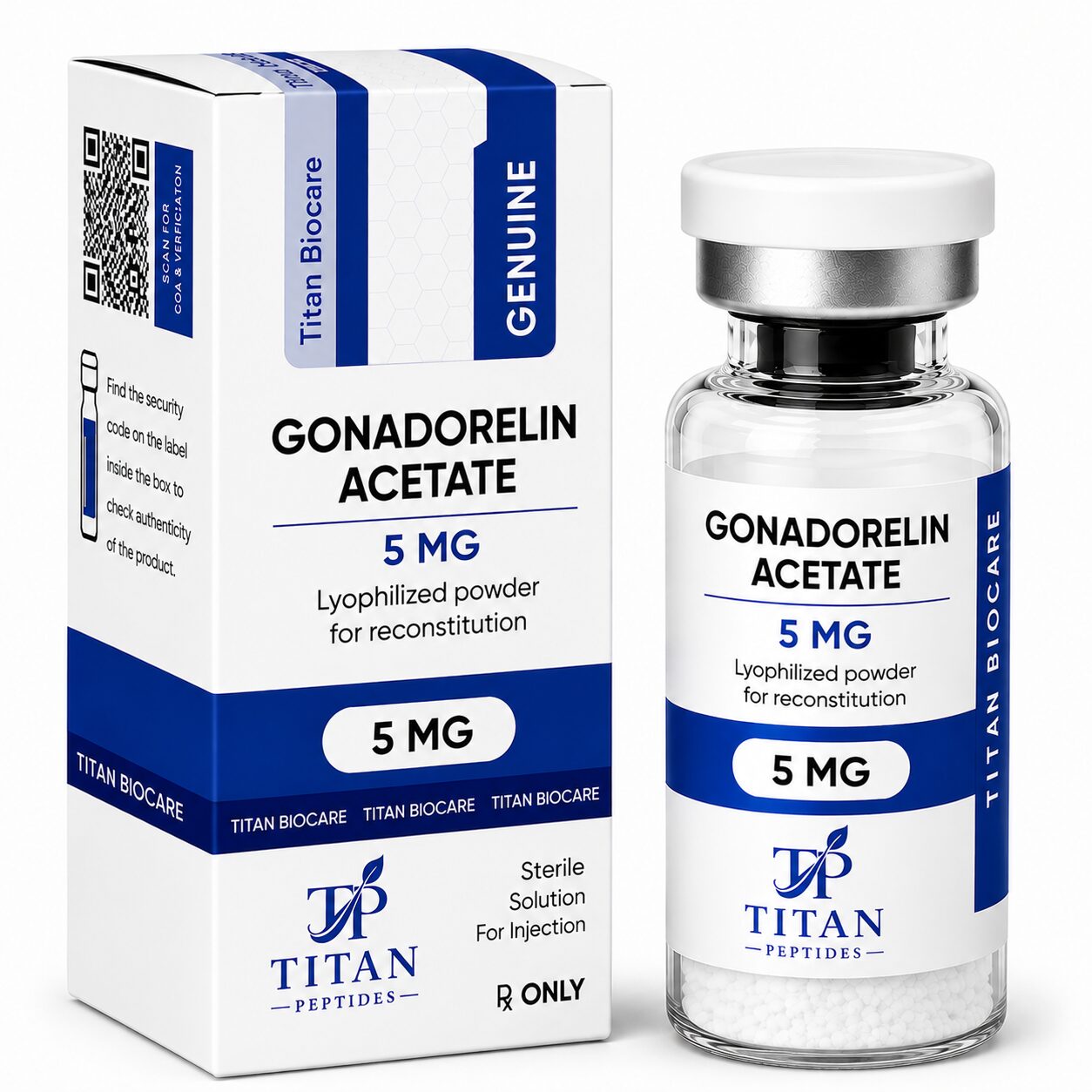
Gonadorelin Acetate 5mg 1kit
$59.00
Gonadorelin Acetate is a synthetic GnRH decapeptide intended for laboratory and in vitro research applications. It is provided at >99% purity and includes a complete third-party Certificate of Analysis. **For laboratory and in vitro research use only. Not intended for human consumption or use as a medicine.**
Gonadorelin | Buy Gonadorelin | Research Use Only
Gonadorelin is a synthetic form of gonadotropin-releasing hormone (GnRH), the naturally occurring hypothalamic decapeptide involved in regulating luteinizing hormone (LH) and follicle-stimulating hormone (FSH) release from pituitary gonadotroph cells. Because its structure corresponds closely to endogenous GnRH, it is widely studied as a reference compound in research involving the hypothalamic-pituitary-gonadal (HPG) axis, GnRH receptor activity, pituitary signalling, and reproductive endocrinology.
For research applications, gonadorelin provides researchers with a useful model for investigating how GnRH receptor activation influences LH and FSH secretion. Its biological effects are strongly influenced by exposure pattern, with pulsatile signalling producing different responses from prolonged receptor stimulation.
This research material is intended exclusively for controlled laboratory and scientific research and is not intended for human consumption, self-administration, diagnosis, treatment, or therapeutic use.
What Is Gonadorelin?
Gonadorelin is the synthetic form of gonadotropin-releasing hormone, commonly abbreviated as GnRH. It is a decapeptide containing ten amino acids and corresponds to the naturally occurring GnRH sequence.
GnRH is produced by specialised neurons in the hypothalamus and released into the pituitary portal circulation in rhythmic pulses. These pulses interact with GnRH receptors on anterior pituitary gonadotroph cells and initiate signalling pathways involved in LH and FSH synthesis and release.
Unlike modified GnRH agonists, native gonadorelin provides a useful physiological reference because its structure corresponds to endogenous GnRH. This makes it particularly relevant for research examining receptor activation, pulse frequency, pituitary responsiveness, and comparisons between native GnRH and structurally modified compounds.
Gonadorelin for Men
Research involving gonadorelin for men commonly examines the male HPG axis, pituitary gonadotropin signalling, LH and FSH regulation, and the relationship between GnRH signalling and testicular function.
After GnRH receptor activation, LH primarily acts through receptors on Leydig cells, while FSH acts on Sertoli cells. These pathways are involved in steroidogenic and spermatogenic processes, making the GnRH-LH/FSH pathway an important subject within reproductive endocrinology research.
Research applications involving male models can include:
- Male HPG axis signalling
- GnRH receptor activity
- LH and FSH secretion
- Pituitary responsiveness
- Hypogonadotropic hypogonadism models
- Spermatogenesis research
- Reproductive hormone regulation
- GnRH pulse-frequency studies
- Comparative endocrine research
The term gonadorelin for men describes a research application rather than a separate molecular form of the peptide.
Gonadorelin Acetate Buy Gonadorelin
Gonadorelin acetate refers to an acetate salt form of gonadorelin. The active peptide corresponds to GnRH, while acetate represents the associated salt component.
The chemical form of a research material can be relevant when evaluating formulation, stability, analytical characterization, and experimental reproducibility.
Gonadorelin is commonly identified by CAS number 33515-09-2 and has a molecular weight of approximately 1,182.3 Da.
How Does Gonadorelin Work?
Gonadorelin interacts with GnRH receptors located on pituitary gonadotroph cells. These receptors belong to the G protein-coupled receptor family.
Receptor activation stimulates intracellular signalling pathways involving phospholipase C, IP3, DAG, calcium mobilisation, and protein kinase C. These processes contribute to the synthesis and secretion of LH and FSH.
One of the defining characteristics of GnRH biology is that the response depends heavily on the pattern of stimulation. Intermittent exposure can promote gonadotropin secretion, whereas prolonged receptor activation can result in receptor desensitisation and reduced gonadotropin output.
This makes gonadorelin particularly useful for research investigating temporal signalling and the relationship between GnRH exposure patterns and pituitary function.
Pulsatile GnRH Signalling
Physiological GnRH secretion occurs in pulses rather than as a continuous signal. Researchers can therefore use gonadorelin as a reference compound when investigating how different stimulation patterns influence pituitary signalling.
Pulse-frequency studies can examine relationships between GnRH stimulation and:
- LH secretion
- FSH secretion
- GnRH receptor expression
- Pituitary sensitivity
- Gonadotropin gene regulation
- HPG axis feedback
- Reproductive endocrine signalling
The distinction between pulsatile and continuous exposure is an important consideration in experimental GnRH research because different exposure patterns can produce substantially different biological responses.
Gonadorelin Dosage Buy Gonadorelin
Gonadorelin dosage should not be interpreted as a recommendation for human administration or treatment. Experimental concentration, exposure schedule, preparation method, and other research parameters depend on the specific study model, assay, formulation, and scientific objective.
There is no universal research dosage that applies to every experiment. Researchers should establish experimental parameters using validated laboratory protocols, appropriate scientific literature, institutional procedures, and applicable regulations.
This is particularly important with GnRH because biological activity is strongly influenced by exposure pattern. Pulsatile and continuous exposure can produce substantially different physiological responses.
For this reason, a gonadorelin dosage cannot be determined from product strength alone. Experimental documentation should account for factors such as concentration, preparation conditions, exposure duration, experimental model, and relevant biological endpoints.
Research Applications of Gonadorelin
Gonadorelin is studied across multiple areas of reproductive and endocrine research.
GnRH Receptor Research
Researchers can investigate receptor binding, receptor activation, intracellular signalling, receptor expression, and receptor desensitisation.
Pituitary Function Research
Gonadorelin can be used as a reference compound in experimental models examining pituitary gonadotroph responsiveness and LH/FSH secretion.
HPG Axis Research
The compound provides a direct research tool for examining communication between hypothalamic GnRH signalling, pituitary gonadotropin release, and downstream gonadal pathways.
Male Reproductive Research
Research models can investigate relationships between GnRH signalling, LH and FSH production, Leydig cell activity, Sertoli cell function, and spermatogenic processes.
Hypogonadotropic Hypogonadism Models
Gonadorelin is relevant to experimental models examining impaired GnRH signalling and the consequences of reduced pituitary gonadotropin stimulation.
Pulse-Frequency Research
Because GnRH responses depend partly on stimulation frequency, gonadorelin can be used to investigate how different experimental pulse patterns influence LH and FSH regulation.
Comparative GnRH Research
Native GnRH provides a useful baseline when researchers compare receptor activity, potency, duration, and desensitisation characteristics among different GnRH-related compounds.
Gonadorelin vs GnRH Analogues
Gonadorelin should be distinguished from modified GnRH agonists and antagonists.
Native gonadorelin corresponds to endogenous GnRH, whereas modified GnRH compounds contain structural changes that can alter receptor activity, stability, potency, or duration.
This distinction is important when designing experiments because modified compounds can behave differently from native GnRH with respect to receptor occupancy, half-life, potency, and desensitisation.
Using native gonadorelin as a reference can therefore help researchers establish a physiological baseline when evaluating modified GnRH compounds.
Gonadorelin Chemical Information
| Property | Detail |
|---|---|
| Common name | Gonadorelin |
| Alternative name | Gonadotropin-releasing hormone |
| Abbreviation | GnRH |
| Classification | Synthetic decapeptide |
| Amino acids | 10 |
| CAS number | 33515-09-2 |
| Molecular weight | Approximately 1,182.3 Da |
| Sequence | pGlu-His-Trp-Ser-Tyr-Gly-Leu-Arg-Pro-Gly-NH₂ |
| Primary research target | GnRH receptor |
| Main downstream hormones studied | LH and FSH |
| Research form | Lyophilised peptide |
Gonadorelin Stability and Storage
Gonadorelin is a peptide and should be handled according to validated laboratory storage procedures. Factors such as temperature, moisture, light, formulation, and repeated environmental exposure can influence peptide stability.
Researchers should follow the storage requirements associated with the specific research material and maintain appropriate laboratory documentation.
Where experimental reproducibility is important, researchers should also record batch information, preparation conditions, storage history, and available analytical documentation.
Quality and Purity
Appropriately characterized research material should be accompanied by analytical documentation. Depending on the material and testing process, this may include high-performance liquid chromatography (HPLC), mass spectrometry, identity testing, and a Certificate of Analysis.
Purity should be evaluated using the underlying analytical documentation rather than relying solely on a percentage displayed on a product page.
Consistent characterization can help reduce variability between batches and support reproducible laboratory research.
Frequently Asked Questions
Is gonadorelin the same as GnRH?
Yes. Gonadorelin is the name commonly used for synthetic GnRH corresponding to the naturally occurring hypothalamic decapeptide.
What is gonadorelin acetate?
Gonadorelin acetate is an acetate salt form of gonadorelin. The active peptide corresponds to GnRH, while acetate represents the associated salt component.
What is gonadorelin used for in research?
It is studied in GnRH receptor pharmacology, pituitary signalling, LH and FSH regulation, HPG axis research, reproductive endocrinology, and male and female reproductive biology.
Is gonadorelin relevant to male research?
Yes. Gonadorelin is relevant to research examining male HPG axis signalling, LH and FSH regulation, Leydig and Sertoli cell biology, and spermatogenesis-related pathways.
What does gonadorelin dosage mean in research?
It refers to the experimental amount or concentration used within a defined research protocol. There is no universal research dosage because requirements vary according to the model, assay, formulation, and study design.
Does gonadorelin affect LH and FSH?
GnRH receptor activation in pituitary gonadotroph cells stimulates signalling involved in LH and FSH synthesis and secretion. The magnitude and pattern of the response depend on exposure conditions and physiological context.
Does continuous GnRH exposure have the same effect as pulsatile exposure?
No. Pulsatile signalling and prolonged exposure can produce different receptor and gonadotropin responses. Extended GnRH receptor activation can result in desensitisation and reduced gonadotropin secretion.
What is the molecular weight of gonadorelin?
The molecular weight of gonadorelin is approximately 1,182.3 Da.
What is the CAS number for gonadorelin?
The CAS number associated with gonadorelin is 33515-09-2.
Research-Use Disclaimer
Gonadorelin described on this page is intended strictly for laboratory, analytical, educational, and pre-clinical research. It is not intended for human consumption, self-administration, veterinary use, diagnosis, treatment, prevention of disease, or any therapeutic application.
Research materials should only be handled by appropriately qualified personnel operating within a controlled laboratory environment and in accordance with applicable laws, institutional requirements, and established safety procedures.
The information provided is for scientific and educational purposes and should not be interpreted as medical advice, a treatment protocol, or a recommendation for human use.
Be the first to review “Gonadorelin Acetate 5mg 1kit”
Related products
Reviews
There are no reviews yet.