Peptide & Growth Hormone
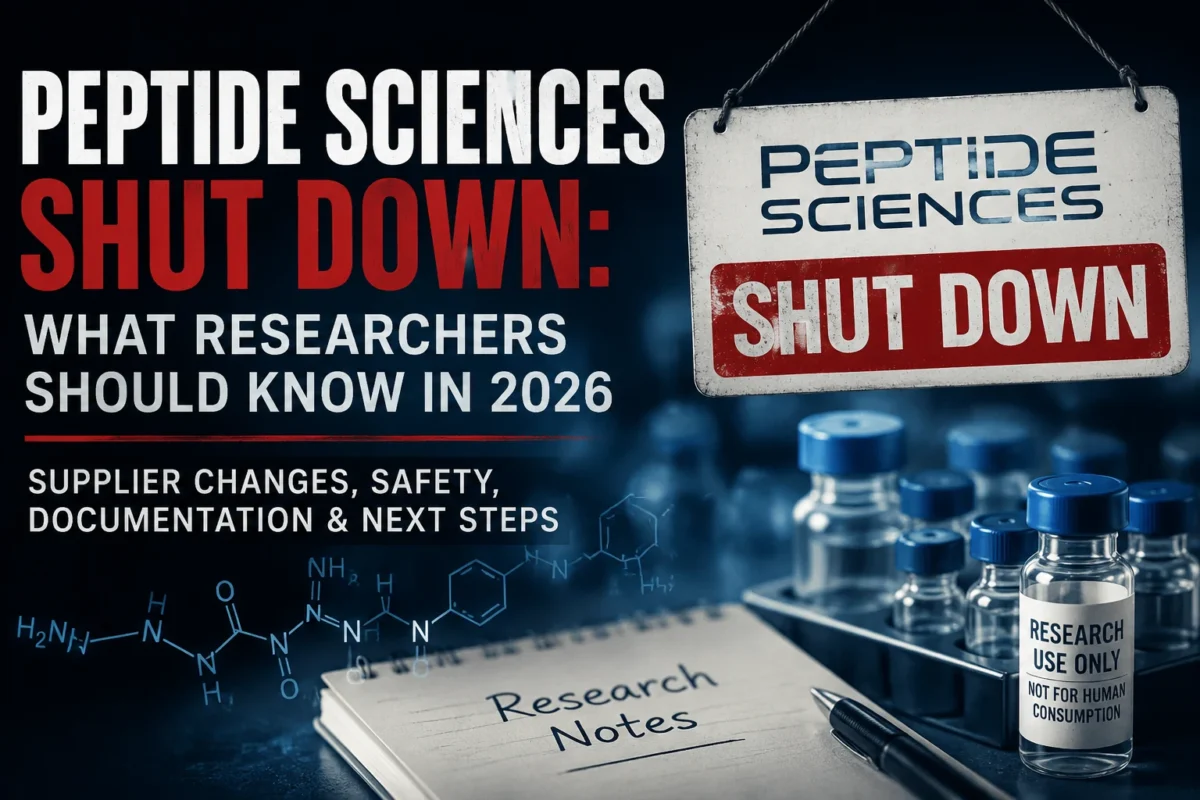
Peptide Sciences Shut Down: What Researchers Should Know in 2026
Aug
The research peptide industry has experienced a major change in 2026 following the shutdown of Peptide Sciences. For years, the company was a recognizable name among people involved in laboratory and analytical research, making its closure an important development for researchers who previously sourced materials through the company.
The shutdown has naturally created questions. What happened to Peptide Sciences? Is the company coming back? What should researchers do if they previously relied on its products? And perhaps most importantly, how can researchers evaluate alternative suppliers without compromising documentation, traceability, or research standards?
This guide looks at the situation from a research-sourcing perspective. Rather than focusing on rumors surrounding the closure, the goal is to explain what researchers can reasonably verify, what they should be cautious about, and what the broader Peptide Science market can learn from the event.
What Happened to Peptide Sciences?
Peptide Sciences announced in 2026 that it was voluntarily shutting down its operations and discontinuing sales of its research products.
The announcement generated considerable attention because the company had become a familiar name within the research peptide market. Researchers who had previously used the company as a source were suddenly faced with the need to identify alternative suppliers and reassess how they source research materials.
One important point is that the company’s public announcement described the shutdown as voluntary. Researchers should distinguish that confirmed statement from speculation circulating through forums, social media, and other online communities.
When a company closes, there can be many theories about the reasons behind the decision. Unless those reasons are confirmed by the company or reliable documentation, they should not be presented as established facts.
For researchers, the more practical question is what happens next.
Why the Closure Matters
A supplier shutdown can affect research workflows in several ways.
Researchers may have established purchasing procedures based around a particular supplier. Existing laboratory records may reference products, lot numbers, or certificates from that supplier. Research projects may also have been planned around the availability of specific materials.
When that source disappears, replacing a product is not necessarily as simple as finding another website selling something with the same name.
Different suppliers may use different quality-control procedures, analytical methods, documentation standards, packaging practices, and lot-identification systems.
That is why the Peptide Sciences situation is relevant beyond one company.
It demonstrates the importance of supplier diversification and documentation in modern research.
The Difference Between Product Availability and Supplier Quality
One of the easiest mistakes researchers can make is assuming that a supplier with a large catalog is automatically a reliable supplier.
A website can list dozens or hundreds of compounds. That alone does not tell a researcher how those materials were tested, whether documentation corresponds to individual batches, or how consistently quality is controlled.
A more useful approach is to separate availability from verification.
Availability answers:
Does the supplier offer the material?
Verification asks:
- Is the material clearly identified?
- Is the quantity clearly stated?
- Is batch or lot information available?
- Is analytical documentation provided?
- Does the documentation correspond to the product supplied?
- Are the testing methods identified?
- Can the supplier be contacted?
- Is the company’s research-use positioning clearly stated?
These questions become particularly important when switching suppliers after the closure of a familiar company.
What Is a COA and Why Does It Matter?
A Certificate of Analysis, commonly called a COA, is an important piece of documentation associated with many research materials.
A COA can provide analytical information about a particular batch or lot. Depending on the material and testing laboratory, documentation may include information from analytical techniques such as high-performance liquid chromatography (HPLC), mass spectrometry, or other applicable methods.
However, simply having a document labeled “COA” does not automatically establish that a product is high quality.
Researchers should look at the details.
A useful document should provide enough information to connect the analysis to the material being supplied. Batch or lot identification is particularly useful because it allows researchers to connect the documentation with a specific product.
This is one reason batch-level documentation is more informative than a generic certificate that could theoretically apply to multiple production runs.
Batch Traceability Is Increasingly Important
Traceability is one of the most overlooked parts of research material sourcing.
Imagine a laboratory receives a research material and records only the product name and quantity. Months later, the researcher needs to determine which batch was used in a particular experiment.
Without a lot number or other identifying information, connecting the experiment to the original material can become difficult.
A stronger recordkeeping system can include:
- Product name
- Quantity received
- Lot or batch number
- Date received
- Supplier
- Certificate of Analysis reference
- Storage information
- Relevant laboratory notes
The exact requirements depend on the research environment, but the principle is straightforward: researchers should be able to establish what material was used and where it came from.
The Peptide Sciences shutdown is a useful reminder of why maintaining these records matters.
What Researchers Should Do If They Previously Used Peptide Sciences
Researchers who previously purchased from Peptide Sciences do not necessarily need to abandon their existing records or research documentation.
Instead, they should organize what they already have.
If previous purchases were made through the company, researchers may have invoices, order confirmations, COAs, lot numbers, product specifications, or other records.
Keeping these records organized can be useful for historical research documentation and laboratory traceability.
Researchers should also be cautious about websites that suddenly appear claiming to be connected to the original company.
A shutdown can create opportunities for impersonation, misleading websites, or businesses attempting to capitalize on an established name.
Watch for Peptide Sciences Impersonation
Searches for Peptide Sciences may continue to produce websites, advertisements, social-media accounts, and other references using the company’s name.
That does not necessarily mean those sources are operated by the original company.
Researchers should verify the identity of any supplier before submitting personal information or payment details.
Look carefully at:
- The domain name
- Company contact information
- Business identity
- Product documentation
- Terms and policies
- Research-use statements
- Payment instructions
- Consistency between the website and its documentation
Researchers should be especially cautious when a website claims to have “returned” without a clear official announcement supporting that claim.
A familiar logo or product name is not sufficient evidence of authenticity.
How the Shutdown Changes Supplier Evaluation
Before the closure, a researcher might have been comfortable using a familiar supplier simply because previous orders had been straightforward.
After a shutdown, the process changes.
Researchers now have an opportunity to reassess what actually matters when selecting a supplier.
Instead of asking only:
“Who sells this product?”
A better question is:
“Which supplier can provide sufficient information and documentation for responsible laboratory research?”
That shift can improve sourcing decisions.
What Makes a Research Supplier Worth Considering?
There is no single feature that automatically makes a supplier suitable for every research environment.
However, several characteristics can help researchers conduct a more informed evaluation.
Clear Product Identification
Product pages should clearly identify what is being offered.
Names should be consistent across the product page, order documentation, and available analytical records.
Ambiguous descriptions make research documentation more difficult.
Accessible Quality Documentation
Researchers should be able to understand what quality documentation is available before making a purchase.
If a supplier provides COAs, researchers should examine whether those documents contain meaningful information and whether they can be connected to specific batches.
Lot or Batch Information
Lot identification supports traceability.
A supplier that maintains clear batch records gives researchers a stronger basis for connecting purchased materials to documentation.
Transparent Research Positioning
Research suppliers should clearly communicate the intended use of their products.
Materials marketed for laboratory research should not be presented as treatments, medicines, or substitutes for approved medical products.
This distinction is particularly important in an industry where online marketing can sometimes blur the difference between laboratory research and consumer health claims.
Why Researchers Should Avoid Health Claims
The shutdown of a major supplier is also a useful reminder that research materials and medical products are not the same thing.
Peptides can be discussed extensively online in connection with areas such as metabolism, inflammation, tissue research, neurological research, and other scientific fields.
However, laboratory findings do not automatically establish that a compound is safe or effective for use in humans.
Research literature may describe experimental observations without establishing an approved medical application.
For this reason, researchers evaluating suppliers should pay attention to how products are described.
Responsible research-focused communication should distinguish between:
What has been studied
and
What has been medically established.
That distinction protects both researchers and the integrity of scientific communication.
The Broader Peptide Science Landscape
The Peptide Sciences shutdown has also highlighted how quickly the research-supplier landscape can change.
Researchers often focus on the compound itself, but supplier stability can be just as relevant to long-term research planning.
A research project may require consistent sourcing over an extended period. If a supplier suddenly disappears, researchers may have to repeat qualification processes with another source.
That can create additional administrative work and may introduce another variable into a research workflow.
This is one reason researchers should avoid treating a supplier’s brand name as the only measure of reliability.
Instead, they should build sourcing decisions around documentation and objective information.
Should Researchers Choose the Cheapest Supplier?
Price can obviously matter when purchasing research materials, but it should not be the only consideration.
A lower price does not necessarily indicate better value if documentation is limited or if the researcher cannot establish adequate traceability.
Likewise, a higher price does not automatically guarantee superior quality.
The better approach is to compare the complete offering.
Researchers can consider:
Documentation: What analytical information is available?
Traceability: Can the material be connected to a specific batch?
Transparency: Is the supplier clear about what it sells and how it is intended to be used?
Communication: Can researchers obtain answers to reasonable product questions?
Consistency: Does the supplier maintain clear documentation across products and batches?
Price can then be considered alongside these factors rather than in isolation.
A More Careful Approach to Research Sourcing
The biggest lesson from the Peptide Sciences closure may be that researchers should treat supplier evaluation as part of the research process itself.
A supplier is not simply a website where a product is purchased.
The supplier becomes part of the chain of documentation surrounding the research material.
For that reason, researchers should develop a repeatable evaluation process.
Before selecting a new supplier, they can review the company’s documentation, product information, lot identification, stated research-use policies, contact channels, and overall transparency.
Keeping these checks consistent can make future sourcing decisions easier.
What Comes Next?
The research peptide market will continue to evolve.
Some suppliers will expand, others may change their business models, and some may disappear entirely. Researchers cannot control those changes, but they can control how carefully they evaluate the sources they use.
The closure of Peptide Sciences should therefore be viewed not only as the end of a familiar supplier, but also as an opportunity to think more critically about research sourcing.
The most important questions are not simply whether a supplier has a particular peptide in stock.
The more important questions are whether the material can be properly identified, whether supporting documentation is available, and whether the supplier communicates clearly about research use.
Looking Beyond a Familiar Name
For researchers who previously relied on Peptide Sciences, changing suppliers can initially seem inconvenient.
But the transition can also encourage better sourcing practices.
Instead of searching for an exact replacement based solely on product catalog size, researchers can compare suppliers according to documentation, traceability, transparency, and research-focused policies.
That approach creates a more defensible sourcing process and reduces dependence on any single commercial supplier.
The broader lesson from the Peptide Sciences shutdown is simple:
A supplier’s name matters less than the quality of information available to evaluate what you are receiving.
Peptide Sciences Shutdown: Evaluating Research Suppliers in 2026
The shutdown of Peptide Sciences has given researchers another reason to look closely at how research materials are sourced, documented, and evaluated.
When a familiar supplier disappears, the obvious reaction is to search for another company offering the same catalog. However, a better approach is to step back and evaluate the information available from each potential supplier.
For researchers working with compounds such as BPC-157, Semax, Selank, Ipamorelin, GHRP-2, GHRP-6, MOTS-C, AHK-Cu, and PT-141, the same basic principles apply: product identification, batch documentation, analytical information, traceability, and clear research-use positioning should all be considered.
The goal should not simply be replacing one website with another. The goal should be developing a more reliable sourcing process.
How to Evaluate an Alternative Research Peptide Supplier
There are several factors researchers can consider when comparing suppliers after the Peptide Sciences shutdown.
No single factor proves that a supplier is suitable for every laboratory. Instead, researchers should look at multiple pieces of information together.
1. Start With Product Documentation
Documentation should be one of the first things researchers review.
For example, if a laboratory is researching BPC-157, the product page should clearly identify the material being offered and provide relevant information about the stated quantity and available analytical documentation.
The same principle applies when researching compounds such as Semax or Selank.
Researchers should avoid assuming that two suppliers offering products with identical names necessarily provide materials with identical specifications.
Product names are only one part of the evaluation.
2. Look for Batch-Specific COAs
A Certificate of Analysis can provide useful information about a particular research material.
When reviewing a COA, researchers can look for details such as:
- Product or compound identification
- Batch or lot number
- Testing date
- Reported purity
- Analytical method
- Testing laboratory information
- Reference numbers where applicable
A batch number is especially useful because it helps connect the document to the material received.
For example, if a laboratory orders Ipamorelin, researchers should ideally be able to determine which lot the supplied material belongs to and locate documentation corresponding to that lot.
This creates a stronger chain of traceability.
Understanding Analytical Testing
Different analytical methods provide different types of information.
HPLC, for example, can be used to evaluate chromatographic purity. Mass spectrometry can provide information related to molecular mass and identity.
Researchers should therefore pay attention to what a supplier’s documentation actually demonstrates rather than treating a percentage printed on a certificate as the entire quality assessment.
For compounds such as GHRP-6 and GHRP-2, researchers can apply the same documentation review process used for other research materials.
The important point is consistency.
A supplier should ideally provide documentation in a way that allows researchers to understand what was tested and which material the results correspond to.
Product Pages Should Be Clear
A well-organized research product page should make important information easy to locate.
Researchers should not have to guess what a product contains, what quantity is being offered, or whether supporting documentation exists.
Clear product information can also make laboratory recordkeeping easier.
For example, if a researcher is documenting work involving MOTS-C, the product information should be sufficiently clear to distinguish the material from similarly named products or unrelated compounds.
The same applies to products such as AHK-Cu and PT-141.
Clear naming and consistent documentation reduce unnecessary confusion.
Watch for Unreasonable Claims
Another important part of supplier evaluation is reviewing the language used on a website.
Researchers should be cautious when a website makes sweeping claims about what a peptide will do in humans.
A research compound being investigated in scientific literature does not automatically mean that it is an approved treatment.
This distinction is especially important for compounds frequently discussed online in connection with human health.
Responsible research-focused suppliers should clearly distinguish laboratory research from medical use.
Research Use Only Matters
Researchers should pay attention to whether a supplier clearly identifies its products as intended for research use.
Research materials should not be presented as approved medicines or as substitutes for professional medical treatment.
This distinction also helps establish appropriate expectations for customers and researchers.
For example, a product page for Semax can discuss the compound in the context of laboratory research without presenting it as a treatment for a medical condition.
Likewise, a page discussing BPC-157 can provide research-oriented information without making unsupported claims about human therapeutic outcomes.
Don’t Choose a Supplier Based Only on Price
Price comparisons are common when researchers are looking for alternatives to a previous supplier.
However, price should be considered alongside documentation and transparency.
A very inexpensive product may initially appear attractive, but researchers should still ask whether sufficient documentation is available.
At the same time, a higher price does not automatically prove better quality.
A more useful comparison considers the complete offering.
| Factor | What Researchers Can Review |
|---|---|
| Product information | Clear identification and stated quantity |
| COA | Availability and relevant analytical information |
| Batch number | Ability to connect documentation to material |
| Testing | Stated analytical methods |
| Traceability | Order, lot, and documentation records |
| Research-use policy | Clear laboratory-only positioning |
| Communication | Accessible support and product information |
| Price | Cost considered alongside the above factors |
This approach provides a more balanced way to compare suppliers.
Common Warning Signs
Researchers should be particularly cautious when a supplier displays several warning signs at the same time.
Examples can include:
No Supporting Documentation
If a supplier provides no meaningful analytical documentation, researchers may have limited information with which to evaluate the material.
Generic Certificates
A document that appears unrelated to the specific lot being supplied provides less useful traceability than batch-specific documentation.
Unclear Company Information
Researchers should be able to identify who operates a website and how the company can be contacted.
Medical Marketing
Research materials should not be presented through exaggerated medical claims.
Pressure to Pay Quickly
Researchers should be cautious about websites that use aggressive payment deadlines or pressure customers to send funds immediately.
Unusual Payment Instructions
Payment instructions should be reviewed carefully, particularly when they differ significantly from the company’s normal ordering process.
These warning signs do not automatically prove that a supplier is illegitimate, but they justify additional due diligence.
What About Existing Peptide Sciences Products?
Researchers who still have materials previously obtained from Peptide Sciences should maintain their existing records.
Depending on the research environment, records may include:
- Original order information
- Product name
- Lot number
- COA
- Date received
- Storage records
- Experimental documentation
Maintaining this information can help researchers establish which material was associated with historical experiments.
Researchers should also follow the applicable laboratory procedures for handling and documenting research materials.
Should Researchers Switch Suppliers Immediately?
Not necessarily.
The shutdown of Peptide Sciences means researchers may need to identify alternative sources, but changing suppliers should be approached systematically.
If a project is already underway, researchers may want to review their existing documentation and determine what information is needed from a new supplier before making changes to their sourcing process.
The most important thing is avoiding a rushed decision based purely on availability.
A new supplier should be evaluated on its own documentation and practices rather than being assumed to be equivalent to a previous supplier.
Building a Supplier Comparison Checklist
A simple checklist can make future sourcing decisions much easier.
Before selecting a research supplier, researchers can ask:
Does the supplier clearly identify the product?
Is batch or lot information available?
Is a COA available for the relevant material?
Can the documentation be connected to the supplied batch?
Are analytical methods identified?
Is the company transparent about its research-use positioning?
Can the supplier be contacted through established channels?
Are ordering and payment procedures clearly explained?
Does the website avoid unsupported medical claims?
The more questions that can be answered clearly, the easier it becomes to conduct a meaningful supplier comparison.
Why Documentation Can Matter More Than Branding
A recognizable brand can create familiarity, but familiarity should not replace verification.
The Peptide Sciences shutdown demonstrates why researchers should avoid becoming overly dependent on a single supplier’s reputation.
A researcher’s confidence should ultimately come from the information available to evaluate the material.
Documentation allows researchers to build a record around what was purchased and which batch was associated with a particular research activity.
That can be more useful than simply knowing that a product came from a well-known website.
Research Compounds Researchers May Encounter
Researchers searching for alternatives may encounter many different compounds across the current research market.
Examples include BPC-157, Semax, Selank, Ipamorelin, GHRP-2, GHRP-6, MOTS-C, AHK-Cu, and PT-141.
Each compound has its own research literature and scientific context.
However, the supplier evaluation process remains broadly similar.
Researchers should examine the available documentation for the specific material rather than assuming that a supplier’s practices are identical across every product.
This is particularly useful when building internal links on a research website. Individual product pages can provide detailed information about the compound while a broader supplier guide explains documentation, sourcing, and research-use principles.
Frequently Asked Questions
Is Peptide Sciences still operating?
Peptide Sciences announced that it was voluntarily shutting down operations and discontinuing sales. Researchers should rely on official information rather than unverified claims that the company has reopened.
Why did Peptide Sciences shut down?
The company announced the voluntary closure but did not provide a detailed public explanation that establishes a specific reason. Researchers should avoid presenting online speculation as confirmed fact.
What should I look for in a replacement supplier?
Look for clear product information, batch identification, analytical documentation, traceability, transparent research-use policies, and accessible company information.
Are COAs important when purchasing research materials?
COAs can provide useful analytical information about research materials. Researchers should examine whether the documentation corresponds to the relevant product and batch rather than relying solely on the existence of a certificate.
Is a high purity percentage enough to evaluate a product?
No. A stated purity percentage is only one piece of information. Researchers should also consider product identity, batch information, analytical methods, documentation, and traceability.
Should researchers choose the cheapest supplier?
Not necessarily. Price should be evaluated alongside documentation, transparency, testing information, and other supplier characteristics.
Can researchers trust websites claiming to be Peptide Sciences?
Researchers should independently verify any website claiming to represent a previously closed company. A familiar name, logo, or product catalog does not by itself establish authenticity.
The Bigger Lesson From the Shutdown
The Peptide Sciences closure provides an important lesson for the wider research community.
Supplier relationships can change unexpectedly. Websites can close, product catalogs can change, and companies can discontinue operations.
Researchers therefore benefit from maintaining good records and evaluating suppliers based on objective information.
The strongest sourcing process is one that does not depend entirely on a company’s reputation.
Instead, it depends on documentation that can be reviewed, records that can be maintained, and information that allows researchers to understand what they are receiving.
Final Thoughts
The shutdown of Peptide Sciences has created uncertainty for researchers who previously relied on the company, but it also provides an opportunity to take a more careful approach to research sourcing.
Rather than searching for a simple one-for-one replacement, researchers can compare suppliers using consistent criteria.
Product identification, batch-specific documentation, analytical information, traceability, transparent research-use policies, and clear communication are all useful factors to consider.
For researchers working with compounds such as BPC-157, Semax, Selank, Ipamorelin, GHRP-2, GHRP-6, MOTS-C, AHK-Cu, or PT-141, the same principle applies: evaluate the material and its documentation rather than relying solely on the name of the supplier.
The future of the research peptide market will continue to change, but careful documentation and responsible supplier evaluation will remain important.
Research Use Only: This article is provided for educational and research-information purposes. Products discussed on this website are intended strictly for laboratory research and analytical use and are not intended for human or veterinary use. Nothing contained in this article should be interpreted as medical advice, a diagnosis, treatment recommendation, or an endorsement of human consumption.
